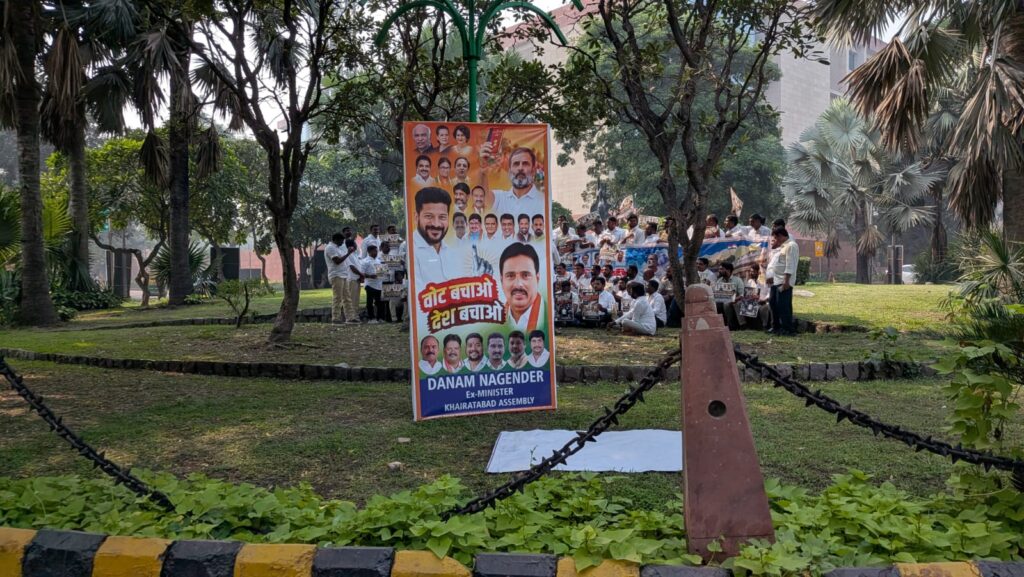
There is an important question that needs to be asked whenever a political party takes to the streets:
If the fight is against alleged vote theft, why is the public being robbed of its time, peace and freedom to move?
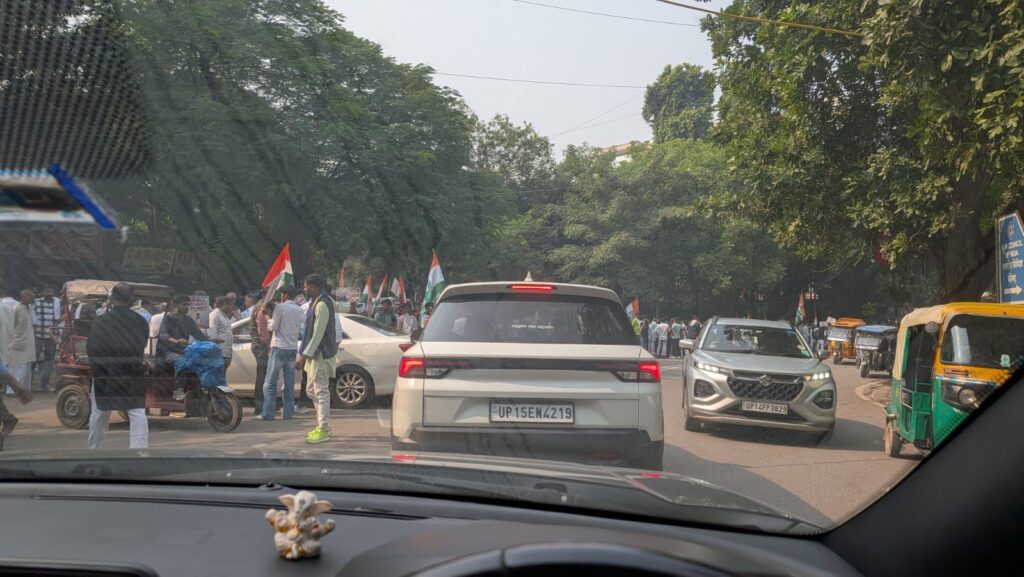
Recently, I witnessed the kind of traffic congestion that makes an ordinary journey unnecessarily frustrating. Roads were crowded with vehicles, including SUVs and Scorpios. Traffic movement was severely disrupted, and people were left struggling to get through.
The photographs accompanying this article capture the situation on the ground.
The political issue may be important. The allegations may deserve serious discussion. But there is another side to this story that often goes unnoticed: the ordinary citizen who has nothing to do with the political dispute but ends up suffering because of it.
A Political Protest, But Who Pays the Price?
Congress and the Samajwadi Party have raised concerns around alleged vote theft and electoral integrity.
These are serious political issues. In a democracy, opposition parties have every right to question the government, demand accountability and mobilise public opinion.
But here is the question:
Why should a person travelling to work, a student going to college, a patient heading to a hospital or a family trying to reach home become an unwilling participant in a political protest?
The person stuck in traffic may not support the ruling party.
They may not support the opposition either.
They may simply want to get to their destination.
Yet they are the ones paying the price.
The Government Is Running. But Is Public Life Running?
A government is expected to ensure that public life functions smoothly.
Roads are not merely political spaces. They are essential public infrastructure.
They are used by:
- Office workers trying to reach their workplaces.
- Students attending classes and examinations.
- Patients and ambulances requiring urgent access.
- Small business owners managing their daily operations.
- Families trying to go about their lives.
When political rallies block roads or create severe congestion, the consequences extend far beyond the rally itself.
A delayed journey can mean a missed appointment, a lost workday, a missed examination or an unnecessary emergency.
And the frustrating part?
Most of these people never agreed to participate in the protest.
If You Want to Protest, Why Not Parliament?
This is not an argument against protests.
Peaceful protest is an essential part of democracy. Political parties must be able to raise concerns, question the government and demand answers.
But there is a difference between exercising a democratic right and making the public bear the cost of that right.
If the issue concerns alleged vote theft, electoral integrity or the conduct of the government, then Parliament, legislative assemblies, election authorities and the courts are all important platforms for pursuing accountability.
Political parties can also organise peaceful demonstrations in designated locations, with proper traffic arrangements and advance planning.
The point is not that politicians should stop protesting. The point is that the public should not be made to suffer unnecessarily because of it.
Public Roads Are Not Private Political Property
A road belongs to everyone.
It does not belong to a political party, a government, a minister or a group of supporters.
The moment a political rally occupies a public road without adequate arrangements, the inconvenience is transferred to thousands of people who have no say in the matter.
Imagine a person sitting in a car for an hour, watching the traffic barely move.
Imagine someone who has to reach a hospital.
Imagine a delivery worker whose earnings depend on completing several deliveries in a day.
For them, a political rally is not a display of democracy.
It is a disruption of everyday life.
And when this happens repeatedly, frustration with the political system grows.
Democracy Should Give People a Voice, Not Take Away Their Time
There is something deeply ironic about a political movement claiming to fight for the rights of citizens while ordinary citizens are left struggling to move through their own city.
If democracy is about the people, then their daily lives should matter too.
The right to protest is important.
But so is the right to move freely, access essential services and go about one’s daily responsibilities.
These rights should not be treated as competing interests when better planning can protect both.
Political leaders should be able to raise their concerns without turning public roads into bottlenecks.
Authorities should ensure that traffic diversions are communicated in advance, emergency routes remain accessible and public inconvenience is kept to a minimum.
And political parties should remember that public support cannot be built by making the public suffer.
The Real Question
Whether the allegation is vote theft, corruption, unemployment or any other political issue, the same question applies:
Why should ordinary citizens suffer for a political fight they did not choose?
If political parties want accountability, they should demand it from the institutions responsible.
If they want to demonstrate, they should do so peacefully and responsibly.
If they want public support, they should respect the public’s time.
Because the people who are stuck in traffic are not political props.
They are citizens.
They are the very people democracy is supposed to serve.
And perhaps the simplest demand is also the most reasonable one:
Raise your voice. Demand accountability. Organise your rally. But please, do not make the public pay the price.
A protest should be a call for justice, not a punishment for ordinary people.