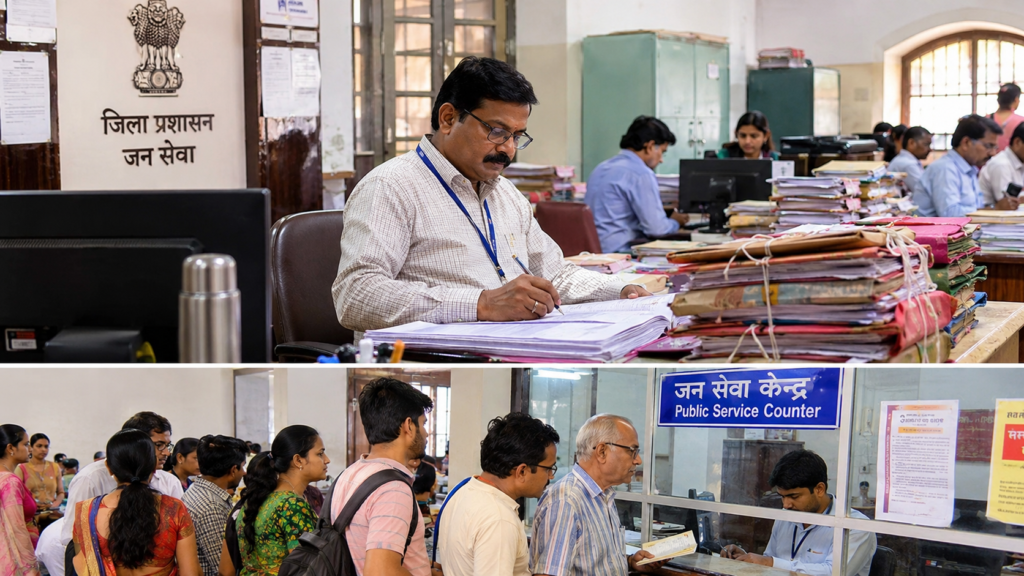
Public service is not just about holding a position. It is about delivering results, respecting citizens, and being accountable for the responsibilities entrusted to you.
When Public Service Becomes a Question of Accountability
Imagine visiting a government office to get a simple document approved. You submit the required paperwork, follow every instruction, and wait patiently. Days turn into weeks, yet your application remains pending.
For a citizen, this is not merely an administrative delay. It can mean lost wages, missed opportunities, unnecessary expenses, and frustration.
Now imagine that the employee responsible for processing the application continues to receive annual increments, promotions, and other benefits, regardless of the quality of service delivered.
This raises an important question:
Should government employees be rewarded for the position they hold, or for the work they actually perform?
The Problem Is Not Government Employment. It Is the Absence of Accountability.
Government employees play an essential role in society. They manage public services, implement policies, maintain records, support citizens, and ensure that essential systems function.
Their work deserves respect, fair compensation, and professional security.
However, public employment also comes with a responsibility that cannot be ignored: serving the public efficiently and honestly.
When an employee performs well, their contribution should be recognised. When performance consistently falls below expectations, there should be a fair and transparent mechanism to address it.
The problem begins when rewards become routine, but performance evaluation becomes optional.
Why Citizens Pay the Price
When accountability is weak, the consequences are often experienced by ordinary citizens.
A delayed file may prevent someone from receiving a pension. An inefficient process may force a small business owner to make repeated visits to an office. An unanswered grievance may leave a person without access to a service they are entitled to receive.
These experiences may appear small when viewed individually. Collectively, however, they can reduce public trust in government institutions.
Every unnecessary delay has a human cost.
Citizens should not have to depend on personal connections, repeated visits, or informal payments to receive legitimate public services.
Rewards Without Evaluation Create the Wrong Incentives
In any organisation, rewards are meant to recognise contribution and encourage better performance.
But what happens when employees receive the same benefits regardless of their performance?
A dedicated employee who consistently completes work efficiently may receive the same recognition as someone who repeatedly delays tasks or avoids responsibility.
Over time, this can discourage hardworking employees and create a culture where meeting minimum expectations becomes sufficient.
The objective should not be to remove employee benefits. It should be to ensure that professional rewards are supported by meaningful performance evaluation.
What Should Government Employee Evaluation Look Like?
A fair evaluation system should focus on measurable outcomes rather than personal opinions.
Some important performance indicators could include:
- Timeliness: Are assigned tasks completed within reasonable deadlines?
- Service quality: Are applications and requests processed accurately?
- Citizen satisfaction: Are citizens treated respectfully and professionally?
- Responsiveness: Are grievances addressed within defined timelines?
- Integrity: Are procedures followed fairly and transparently?
- Productivity: Is the employee contributing meaningfully to the department’s objectives?
Different departments require different performance indicators. A teacher, police officer, healthcare worker, and administrative clerk cannot be evaluated using exactly the same criteria.
The evaluation system must reflect the nature of the work.
Performance Evaluation Should Not Become Harassment
Accountability should never become an excuse for arbitrary punishment.
Government employees may face genuine challenges such as staff shortages, outdated technology, excessive workloads, unclear instructions, and insufficient resources.
A fair system must distinguish between an employee who is unwilling to perform and one who is unable to perform because of circumstances beyond their control.
Employees should have the right to explain their performance, receive feedback, and appeal unfair assessments.
Accountability must be transparent, objective, and fair.
A Better System: Recognise Performance, Address Poor Results
India could strengthen its public-service evaluation framework through a balanced approach.
| Performance | Possible Response |
|---|---|
| Consistently excellent | Recognition, incentives, and career development |
| Meets expectations | Regular benefits and professional support |
| Needs improvement | Training, guidance, and a performance improvement plan |
| Repeatedly poor without valid justification | Formal review and proportionate disciplinary action |
The purpose of evaluation should be to improve public service, not simply to punish employees.
A well-designed system would reward genuine contribution while ensuring that persistent negligence is not ignored.
Technology Can Make Accountability More Transparent
Digital systems can help reduce unnecessary delays and improve the monitoring of public services.
For example, departments could use digital dashboards to track:
- Pending applications
- Average processing time
- Citizen grievances
- Departmental performance
- Service delivery deadlines
Citizens could also receive application status updates and clear information about expected timelines.
However, technology should support human judgement rather than replace it. Performance data must be interpreted carefully, with safeguards against manipulation and unfair assessments.
The Bigger Picture: Public Trust
A government institution is not judged only by its policies or infrastructure.
It is also judged by the everyday experiences of the people who interact with it.
When citizens receive timely, respectful, and reliable service, public trust grows.
When they repeatedly encounter delays, indifference, and a lack of responsibility, that trust begins to weaken.
This is why accountability is not simply an employee-management issue. It is a matter of governance.
The Question We Must Start Asking
Government employees deserve fair salaries, professional security, and opportunities for growth.
But citizens also deserve efficient services, transparent processes, and employees who take their responsibilities seriously.
The two are not opposing goals.
A system that recognises genuine performance can protect hardworking employees while improving the quality of public service.
The question is not whether government employees should be rewarded.
The question is whether those rewards should be accompanied by meaningful evaluation.
Public service deserves respect. Public responsibility deserves accountability.
Because ultimately, the price of no accountability is not paid by the system alone.
It is paid by the citizens the system exists to serve.